.svg "novoserve-dedicated-server-provider-logo")
At NovoServe, our hardware engineers and infrastructure consultants have helped clients for years select the exact bare metal GPU configuration their workloads need. When customers ask whether they should deploy a single gpu dedicated server or a multiple gpu dedicated server, we evaluate their specific parameter size, concurrent user count, and required token generation speed. By matching the workload directly to our pre-configured hardware, such as our rapid-deploy Supermicro X11 series, we prevent costly over-provisioning and ensure an optimal architectural fit.
The RAM versus VRAM dynamic
Before deciding on GPU count, you must address system memory. Loading an LLM follows a strict hardware dependency: system RAM capacity must always exceed the total uncompressed model size. If you are deploying a 120B parameter model, provisioning a minimum of 128GB of system RAM is mandatory. When initial model weights load from NVMe storage, system RAM holds the parameters before transferring active layers to the graphics card. Insufficient system RAM forces the operating system to swap pages to disk, instantly destroying inference latency.
VRAM dictates which models can actively execute and how large your context window can expand. Modern Mixture-of-Experts (MoE) architectures drastically change memory allocation dynamics. Similar to how human cognition activates distinct neural pathways for language versus logic, MoE models route tokens only to specific sub-networks. This sparse activation mechanism allows a 120B parameter MoE model to run efficiently on a 96GB VRAM footprint. You preserve the remaining VRAM for context window buffers, KV caching, and execution state overhead.
A single GPU dedicated server excels at inference
Inference speed depends directly on memory bandwidth. During token generation, GPU cores repeatedly fetch weights from local memory, making bandwidth the primary hardware bottleneck. An enterprise card like the RTX PRO 6000 utilizes High Bandwidth Memory architecture to transfer data internally at a staggering 1600GB/s.
We regularly see architects attempt to lower capital expenditure by splitting an inference workload across multiple consumer-grade cards. Benchmark tests comparing a single 96GB PRO 6000 against a split array of three RTX 5090 32GB cards reveal a severe hardware limit. Data moving between distinct cards must cross the host system's PCIe bus, which is physically capped at 64GB/s.
This 25-fold bandwidth drop stalls GPU compute cycles while layers exchange context data across the bus. Because real-time token processing relies on uninterrupted internal data flow, a single GPU dedicated server is substantially faster and more efficient for AI agents and production inference endpoints.
When to choose a multiple GPU dedicated server
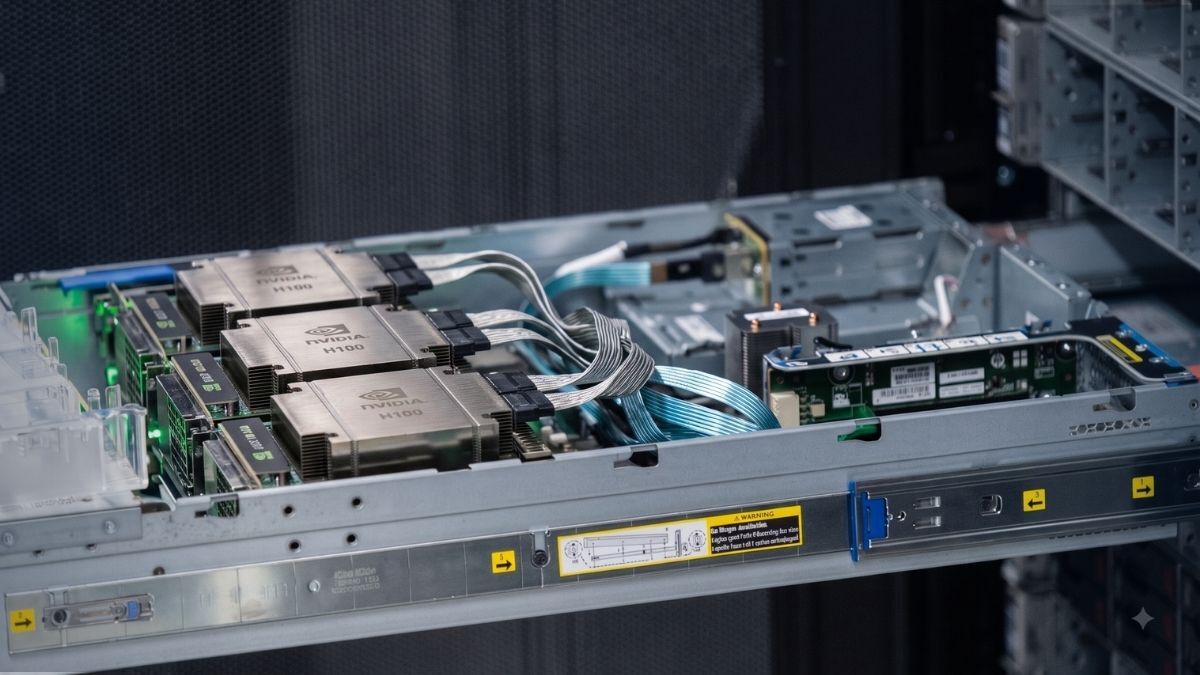
While single-card setups maximize performance for individual inference instances, model training requires continuous, massive cross-GPU parameter synchronization. Dedicated training environments absolutely rely on enterprise multiple GPU dedicated server platforms equipped with high-speed interconnects, such as the NVIDIA H100 (900GB/s NVLink) or B300 (1800GB/s NVLink).
However, these training platforms carry a capital expenditure roughly three times higher than workstation-class cards, alongside massive power and cooling demands. For standard API inference workloads, self-hosting these training clusters is cost-prohibitive.
A multiple GPU dedicated server also proves highly cost-efficient in multi-user scaling environments. Enterprise platforms serving concurrent client requests require dense multi-card architecture. Deploying a quadruple GPU dedicated server—placing four RTX PRO 6000 GPUs inside a single Supermicro chassis—allows managed service providers to run isolated inference instances side by side. Multi-tenant workloads run on dedicated physical cards without competing for system resources or crossing PCIe boundaries, maximizing the return on hardware investment.
Renting bare metal for superior economics
Working with specialized bare metal GPU providers like NovoServe allows development teams to bypass high public cloud margins and bypass power infrastructure management entirely. We provision dedicated Supermicro servers connected directly to our 19+ Tbps global network backbone.
Matching physical GPU footprints strictly to model scale gives hosting resellers and SaaS developers full control over operational costs and inference speeds. By renting unmanaged physical compute directly, you secure unthrottled external bandwidth alongside dedicated internal PCIe lanes.