.svg "novoserve-dedicated-server-provider-logo")
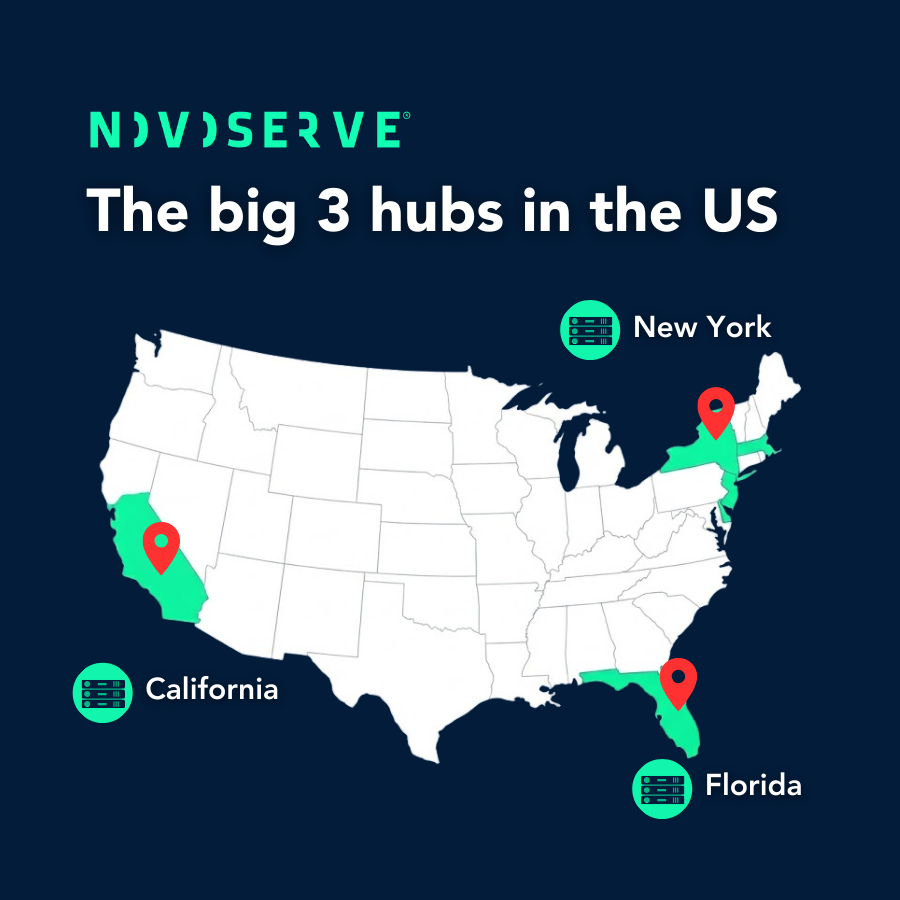
Selecting a US-based dedicated server is not a simple matter of choosing a "tier" of hardware; it is much dictated by the physical reality of fiber-optic glass and the economic fluctuations of regional energy markets. As the US moves toward a more fragmented data landscape, the gap between the "Big Three" hubs—the New York Metro, Los Angeles, and Miami—has widened.
For businesses with global operations, the choice of a host city goes beyond the server configs or GPUs. Let’s compare and look at the big three US hosting hubs.
New York: The Transatlantic Gateway
The New York metropolitan area remains the undisputed king of international connectivity. Our Edison, New Jersey data center is strategically positioned at the heart of the "subsea shortcut." This region serves as the primary landing station for the AEC-1 and Hibernia Express cables, which provide the fastest possible routes to London and Amsterdam.
But New York's strength isn't just about the cables in the ocean. It’s about the "Network of Networks" on land. The region is home to the world's most robust internet exchanges, such as NYIIX and DE-CIX New York. These exchanges allow servers to "peer" directly with thousands of other networks—meaning your data takes a single "hop" to reach Google, Amazon, or a major European ISP, rather than bouncing through multiple congested intermediaries.
In the recent benchmarking results on serververify.com, NovoServe’s US network is ranked in the top 7.39% globally on ServerVerify.com, earning a "A" grade. While many providers rely on congested, "best-effort" transit to keep costs low, our 20 Gbps unmetered links prioritize throughput and stability.
The experts at letshosting.com recently also highlighted our New York facility for its minimum latency. They noted that for businesses requiring consistent uptime and minimal latency in North America, this hub is a "key highlight." With pings to London reaching as low as 68ms and Amsterdam at 84ms, our New York-area infrastructure provides a "local" experience for European users that other US hubs simply cannot match.
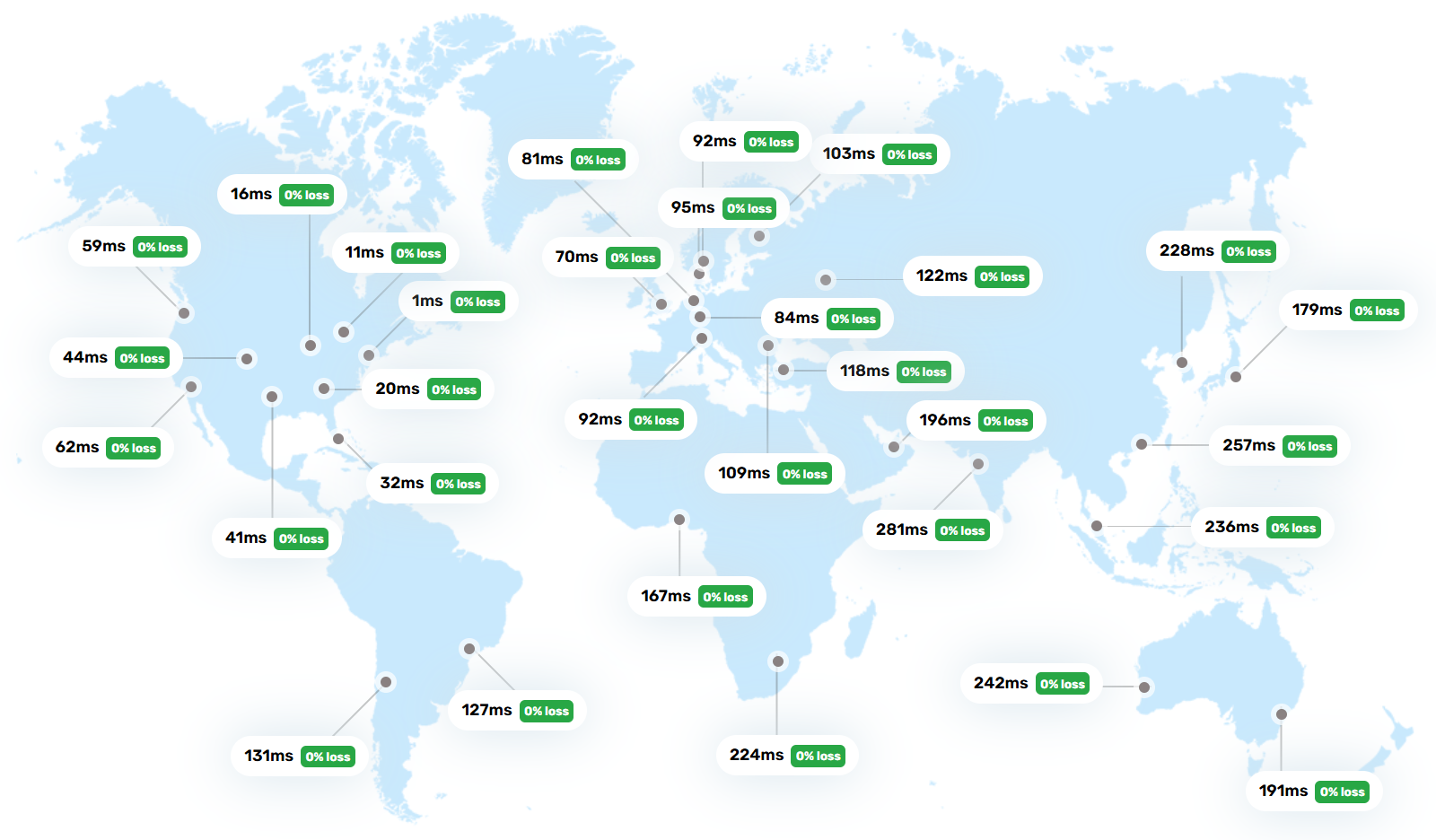
You can take a look at the global latency map of our New York-hosted dedicated servers. The latency from New York stays mostly below 40ms within the US except for the West Coast, and to the most European hubs roughly 80ms.
Los Angeles: The Pacific Bridge
Los Angeles is the premier choice for companies targeting the Pacific Rim, including Japan, South Korea, China, Taiwan, and Australia. If your user base is concentrated in Asia, the West Coast is the logical choice. However, for any business with a European or even a significant East Coast audience, Los Angeles carries a hidden "continental tax."
Data traveling from Los Angeles to Europe must first traverse 3,000 miles of the American mainland before it reaches the Atlantic subsea landing stations. This adds a minimum of 60ms to 70ms of base latency before the ocean crossing even begins. For high-speed bidding platforms, AI inference, or real-time streaming, this added distance is a key factor to weigh against its Pacific strengths. LA is excellent for a West-focused strategy, but less efficient as a global bridge to the EMEA region.
Furthermore, while Los Angeles has high density, the network paths are often more "hoppy" and congested than the direct fiber paths available in the New York Metro area.
Miami: The LATAM Gateway
Miami is often marketed as the "Gateway to the Americas" due to its proximity to Latin America and the Caribbean. It is the go-to location for businesses targeting Brazil, Colombia, or Mexico, offering ultra-low latency to these growing markets. As digital adoption in South America continues to surge, Miami’s role as a regional bridge is more important than ever. While it is an excellent choice for a Brazilian or Colombian audience, it is a specialized hub with significant drawbacks for broader international use.
From a bandwidth perspective, Miami operates in a unique market. While it offers excellent regional peering, the cost of high-capacity transit can be higher than in the New York metro due to differing levels of provider competition at local exchanges and higher operational costs. Additionally, routing from Miami to Europe typically loops northward through the New York Metro area anyway. This means a server in Miami essentially adds the latency of the entire US East Coast to your connection, making it roughly 30ms to 40ms slower to Europe than a server in New Jersey.
It should also be noted about the cost of bandwidth in Florida. Unlike the highly competitive and fiber-rich environment of New York, Miami has fewer massive peering exchanges (like the NYIIX). This lack of competition, combined with higher regional energy and maintenance costs, means that 10Gbps unmetered connectivity often comes with a significant price premium.
Connectivity & Latency Benchmarks
Below you can find a table of the latest benchmarks on the average latency across the three hubs.
|
Route |
New York |
Miami |
Los Angeles |
|
To Amsterdam (NL) |
~84ms |
~132ms |
~165ms |
|
To London (UK) |
~67ms |
~115ms |
~140ms |
|
To Frankfurt (DE) |
~83ms |
~140ms |
~158ms |
|
To Sao Paulo (BR) |
~110ms |
~95ms |
~180ms |
|
To Tokyo (JP) |
~160ms |
~185ms |
~92ms |
Power and Stability
In early 2026, New York State introduced new initiatives requiring data centers to shoulder more of the cost for grid stability. While this has caused some smaller providers to hike prices or lower performance, NovoServe’s position in our Tier III Iron Mountain facility in New Jersey provides a layer of protection. Our facility is built to a FISMA High and SOC 2 Type II standard, ensuring that even as the US grid faces "power crunches" due to AI growth, our infrastructure remains stable and compliant.
Eventually, you should base your choice on your primary user base, and take into consideration other factors such as the bandwidth costs. Choose New York, if your paltform needs a direct, low-latency "subsea shortcut" to Europe. This is the optimal hub for VPNs, FinTech, and global streaming. Choose Los Angeles if you want to target specifically for Asia-Pacific traffic, while accepting higher latency for the US East Coast and Europe. Go for Miami if you have Latin American projects, but do note the higher bandwidth costs and longer routing to the North Atlantic.
At NovoServe, we provide a verified bridge between continents. By cutting out the physical distance and utilizing Grade-A routing, we ensure your data stays ahead of the competition. You are welcome to do a speedtest on our US facility or request for a test server.