.svg "novoserve-dedicated-server-provider-logo")
The landscape of IT infrastructure is undergoing a seismic shift. For the past decade, the dominant strategy was "Cloud First"—migrate everything to the public cloud for scalability. But as we approach 2026, the narrative has changed. We find ourselves already in the "AI-First" era.
In this new paradigm, generic cloud resources are often too expensive or inefficient for the specialized demands of artificial intelligence and high-performance computing. Businesses are rethinking their foundational technology, leading to a massive resurgence in IT infrastructure solutions that prioritize control, performance, and sovereignty—specifically, dedicated server solutions.
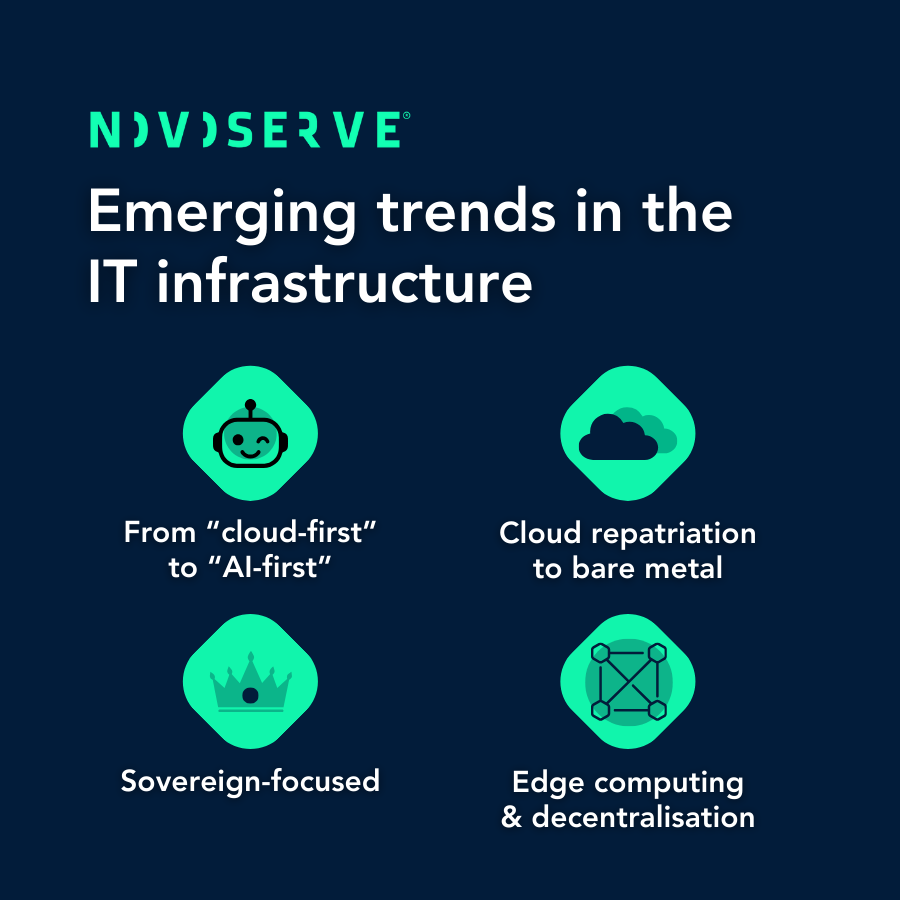
Emerging IT Infrastructure Trends for 2026
The one-size-fits-all cloud model is fracturing. Here are the critical trends reshaping how enterprises build their technology stacks.
The Shift to "AI-First" Infrastructure
No tech company can ignore the AI revolution. But AI isn't just software; it's a hardware problem. Training Large Language Models (LLMs) and running inference requires massive parallel processing power that standard CPUs cannot provide.
We are seeing the trend of organizations moving away from general-purpose computing to specialized, GPU-leveraged infrastructure. This is driving a demand for high-density dedicated servers packed with NVIDIA H100 or A100 GPUs. Public cloud GPU instances are often prohibitively expensive or facing capacity shortages.
It is possible to run AI worklaods on cloud, but building private AI clusters on dedicated hardware ensures you have the guaranteed compute power needed to train models without fighting for shared resources. It is also more budget-friendly.
Cloud Repatriation: The Return to Bare Metal
Cloud repatriation is the strategic move of workloads back from public clouds to on-premises or dedicated data centers. Companies like 37signals (maker of Basecamp) have proven that for steady-state workloads, the public cloud "tax" (egress fees, API costs) destroys margins.They famoulsy pulled Baescamp out of Cloud and saved $7 million in 5 years. You can read more about the cloud exit story of Basecamp on their website. And 37signals is juts one of many.
In reality, not all companeis choose to abandon the cloud entirely, but adopt a Hybrid Strategy. Keep the elastic, bursty frontend on the cloud, but move the heavy databases, storage, and backend processing to dedicated server solutions. We expect a significant recovery of bare metal adoption in 2026 as CFOs look to stabilize IT budgets.
Data Sovereignty & The "Sovereign Cloud"
In 2026, where your data lives matters as much as what it is. With regulations like GDPR (Europe), the US CLOUD Act, and many other regulations around the world, "data sovereignty" has become a boardroom discussion.
Data hosted with US-owned hyperscalers (even in EU data centers) is theoretically subject to US law enforcement access. But data hosted on European cloud providers may be requested by European govermental bodies. More and more tech companeis start to do their legal considerations on data sovereignty.
European enterprises are increasingly seeking sovereign IT infrastructure solutions—providers that are locally owned, operated, and legally domiciled within the EU. This ensures that sensitive data remains strictly under local jurisdiction, free from foreign overreach. Same goes for IT companies of course in other countries.
The Rise of Edge Computing & Distributed Infrastructure
Latency is the new downtime. As applications become more real-time (IoT, autonomous driving, AdTech), processing data in a centralized hub is too slow. Infrastructure is moving closer to the user. We are seeing a surge in demand for distributed dedicated servers in specific geographic regions to act as "Edge Nodes." What are the benefits? Processing data locally reduces bandwidth costs and improves user experience by slashing latency.
How Do We Support Your IT Infra?
At NovoServe, we have anticipated these trends. We have helped some of the fastest-growing tech startups, large enterprises, and leading government agencies optimize their stack for the "AI-First" world.
We provide global dedicated server solutions tailored for specific use cases:
- For AI Innovators: We offer high-performance GPU servers ready to crunch your models.
- For Sovereignty Seekers: As a 100% Dutch-owned company with data centers in the Netherlands, Denmark, and the US, we offer true data sovereignty and compliance.
- For Cost-Conscious Scalers: Our unmetered bandwidth servers eliminate the "egress fee" trap, making cloud repatriation financially viable.
Don't let legacy infrastructure hold you back in 2026.