US streaming platforms lose massive operating margins to public cloud egress fees and congested transit routes. Over the last decade of building bare metal networks for media companies and private CDNs, we have seen the exact same inflection point repeat. A video platform launches on a public cloud, scales past a few thousand concurrent viewers, and watches outbound data transfer bills overtake its compute spend.
The US streaming market
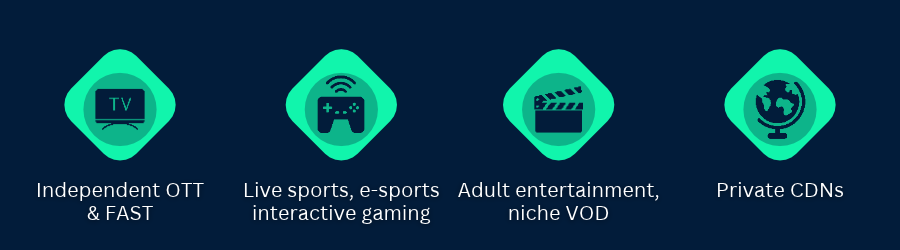
The global stream hosting market hit $6.1 billion in 2025 and is on track to reach $24.1 billion by 2035, expanding at a 14.8% CAGR. North America leads that demand. Outside the household-name subscription giants, the heaviest buyers of US bare metal are mid-market and specialized operators building their own delivery stacks:
- Independent OTT and FAST channels: Free Ad-Supported TV runs on tight CPM margins where per-gigabyte cloud egress wipes out ad revenue.
- Live sports, e-sports, and interactive gaming: Real-time broadcasts depend on sub-second glass-to-glass latency; even a two-second delay breaks live betting, chat sync, and viewer retention.
- Adult entertainment and niche VOD platforms: High-volume video libraries face restrictive content policies and punitive bandwidth tiers on hyperscale clouds.
- Private CDNs and streaming SaaS companies: Engineering teams operating custom edge nodes need raw physical ports, BGP control, and predictable unit economics.
US infrastructure anchors video delivery
The United States is a primary hub for video delivery, whether your viewers sit in North America or overseas. Major US metro areas provide dense fiber-optic backbones, reliable grid power, and lower compute and transit costs than most global regions.
Proximity to the North American tech ecosystem speeds up peering and deployment. Hosting in the New York metro corridor delivers single-digit millisecond latency across the densely populated US East Coast, strong routing into Canada and Latin America, and direct trans-Atlantic fiber paths into Europe. Even for platforms with primary audiences in Europe or Asia, a US-based dedicated server functions as a critical CDN edge node to offload trans-oceanic hops and stabilize playback. With a NovoServe US-hosted dedicated server, you can have sub -40ms latency to major North American and West European hubs thanks to its massive peering and transit network partners.
US cloud providers versus bare metal
Outbound bandwidth (egress) is the largest variable expense in US video streaming. Hyperscalers price internet traffic on tiered per-gigabyte schedules that penalize audience growth.
Current 2026 US list prices for standard internet egress break down as follows:
- AWS EC2 / S3 (us-east-1): $0.09/GB for the first 10 TB, $0.085/GB for the next 40 TB, $0.07/GB for the next 100 TB, and $0.05/GB above 150 TB.
- AWS CloudFront (North America): $0.085/GB for the first 10 TB, stepping down to $0.080/GB and $0.060/GB, plus HTTPS request fees.
- Microsoft Azure: ~$0.085/GB to $0.087/GB standard US egress.
- Google Cloud: $0.12/GB standard US egress, with CDN Interconnect and peering egress rates having doubled from $0.04/GB to $0.08/GB in May 2026.
Apply those rates to real US video bitrates. Standard 1080p Full HD streams average 8 Mbps. 4K UHD (H.265/HEVC) pulls 20 Mbps, while 4K HDR live sports push 25 to 40 Mbps.
Stream a 1080p feed at 8 Mbps to 1,000 concurrent viewers, and your origin pushes 8 Gbps continuously. Scale that to 2,000 concurrent viewers watching a 4K HDR live sports broadcast at 25 Mbps, and peak throughput hits 50 Gbps. Add a standard 15% buffer for traffic bursts and protocol overhead, and your network needs 57.5 Gbps of provisioned headroom.
Even a mid-sized platform pushing 100 TB of egress per month pays roughly $7,800/month on AWS EC2/S3 or $12,000/month on Google Cloud standard egress. On US bare metal, an HPE DL360 G10 with a dedicated 10 Gbps unmetered port starts at $599/month and can push over 3,000 TB of data per month with zero overage fees.
For hybrid architectures—keeping orchestration or databases in AWS while offloading video delivery to bare metal—NovoServe Cloud Connect bypasses public internet egress. Routing over private direct interconnects drops AWS transfer fees to roughly $0.02/GB instead of $0.09/GB, cutting hybrid cloud transfer bills by over 75%.
Unmetered ports for live video streaming
Metered billing turns viral audience spikes into budget emergencies. Unmetered dedicated servers solve that by assigning a physical port you can run at 100% capacity, 24/7/365, for a flat monthly rate.
Because we host a large number of streaming platforms and CDN operators, we size US ports around concurrent viewer counts, bitrate ladders, and a ~13% burst buffer. (For a deeper formula on bitrate calculations, see our guide on how much bandwidth you need to stream.)
|
Dedicated Unmetered Port |
Theoretical Max Monthly Volume |
1080p Full HD (8 Mbps) |
4K UHD (20 Mbps) |
4K HDR Live Sports (30 Mbps) |
|
2 Gbps |
~650 TB |
~215 concurrent viewers |
~85 concurrent viewers |
~55 concurrent viewers |
|
5 Gbps |
~1,650 TB |
~540 concurrent viewers |
~215 concurrent viewers |
~140 concurrent viewers |
|
10 Gbps |
~3,300 TB |
~1,080 concurrent viewers |
~430 concurrent viewers |
~285 concurrent viewers |
|
20 Gbps |
~6,600 TB |
~2,160 concurrent viewers |
~865 concurrent viewers |
~575 concurrent viewers |
|
50 Gbps |
~16,500 TB |
~5,400 concurrent viewers |
~2,160 concurrent viewers |
~1,440 concurrent viewers |
Regional channels and CDN origin servers typically start on 2 Gbps or 5 Gbps unmetered ports. Once a platform crosses 1,000 concurrent HD viewers or shifts to 4K delivery, 10 Gbps and 20 Gbps ports become the baseline. High-volume FAST channels, live sports broadcasters, and edge CDN nodes deploy 50 Gbps ports or multi-server clusters.
Bottlenecks with US streaming hosts
Cheap US bandwidth often breaks down under sustained live video loads. When auditing underperforming North American streaming stacks, five failure points show up repeatedly:
- UDP packet loss and jitter: Live video protocols (WebRTC, SRT, QUIC) rely on UDP, which does not retransmit dropped packets. Oversubscribed transit routes cause immediate frame drops, audio desync, and viewer churn.
- The FUP trap: Budget US hosts advertise "unlimited" 10 Gbps ports while burying Fair Use Policies (FUP) in their terms. Sustain 6 to 8 Gbps for a few days, and the host throttles your port to 1 Gbps.
- Evening prime-time congestion: Hosts using single-carrier or lowest-cost BGP routing push traffic through saturated exchanges, spiking latency right when US viewership peaks.
- Cluster port waste: Leasing five separate 10 Gbps unmetered servers when your fleet peaks at 32 Gbps leaves you paying for idle capacity.
- Transcoding limits: Generating real-time adaptive bitrate (ABR) ladders in H.265 or AV1 chokes standard CPUs. (We break down exact CPU/GPU sizing in our streaming hardware requirements guide.)
We address these bottlenecks at the network and hardware layers. Every NovoServe unmetered port is dedicated and free of Fair Use throttling. For multi-server fleets, our 95th percentile aggregated bandwidth pools let your entire cluster share one traffic pool while ignoring the top 5% of monthly traffic spikes. On the compute side, you can pair 64-core AMD EPYC 7742 servers or dedicated GPU machines (NVIDIA V100 / AMD MI50) with NVMe arrays to handle real-time transcoding and high-I/O VOD caching without disk bottlenecks.
NovoServe for stream hosting
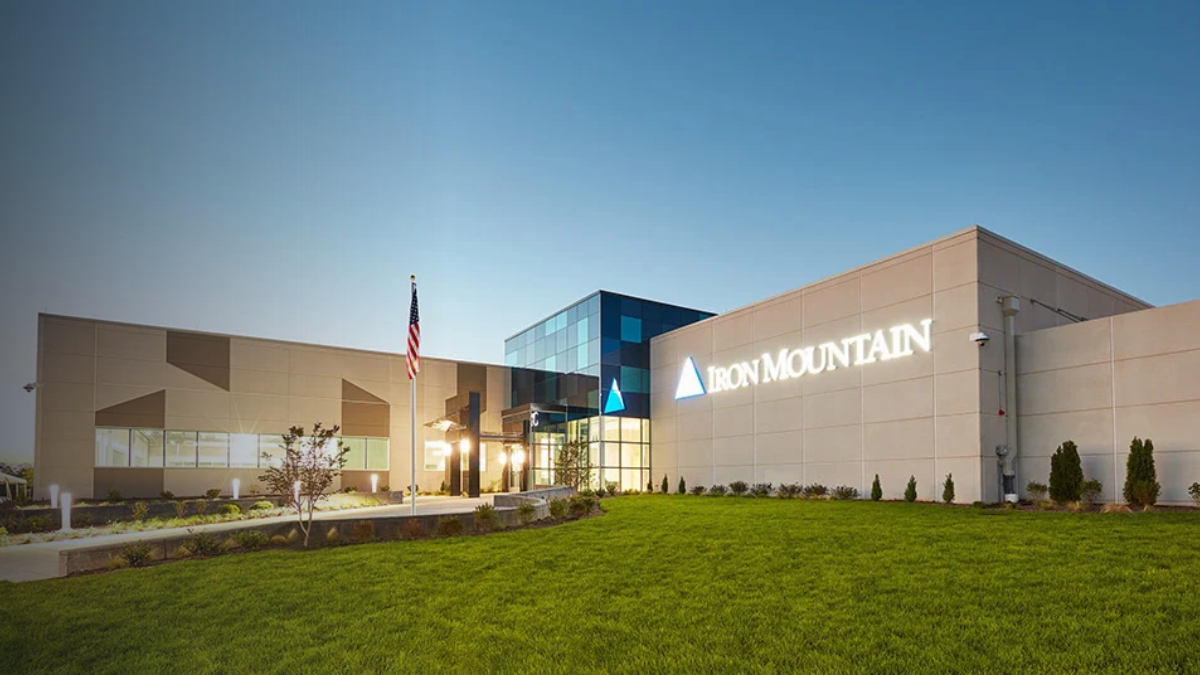
NovoServe’s US infrastructure sits inside a Tier III Iron Mountain data center in Edison, New Jersey—directly in the New York metro connectivity hub. Our US transit backbone runs on a multi-homed blend of Tier-1 carriers, including Arelion (400G), GTT (400G), and Cogent (400G). Noction-optimized routing monitors BGP paths continuously and selects the lowest-latency route for every packet, backed by standard edge DDoS IP protection.
For platforms serving trans-Atlantic or global audiences, our US hub connects alongside our European footprint in the Netherlands and Denmark, backed by an 19+ Tbps network with direct links to AMS-IX, NL-IX, and 800+ peering partners.
Whether you operate live sports, e-sports, FAST channels, adult content, gaming streams, or a private CDN, our US pricing stays transparent—starting at $269/month for 64-core AMD EPYC servers (with 25 TB included traffic and ports upgradable to 20 Gbps) and $599/month for 10 Gbps unmetered US boxes.