.svg "novoserve-dedicated-server-provider-logo")
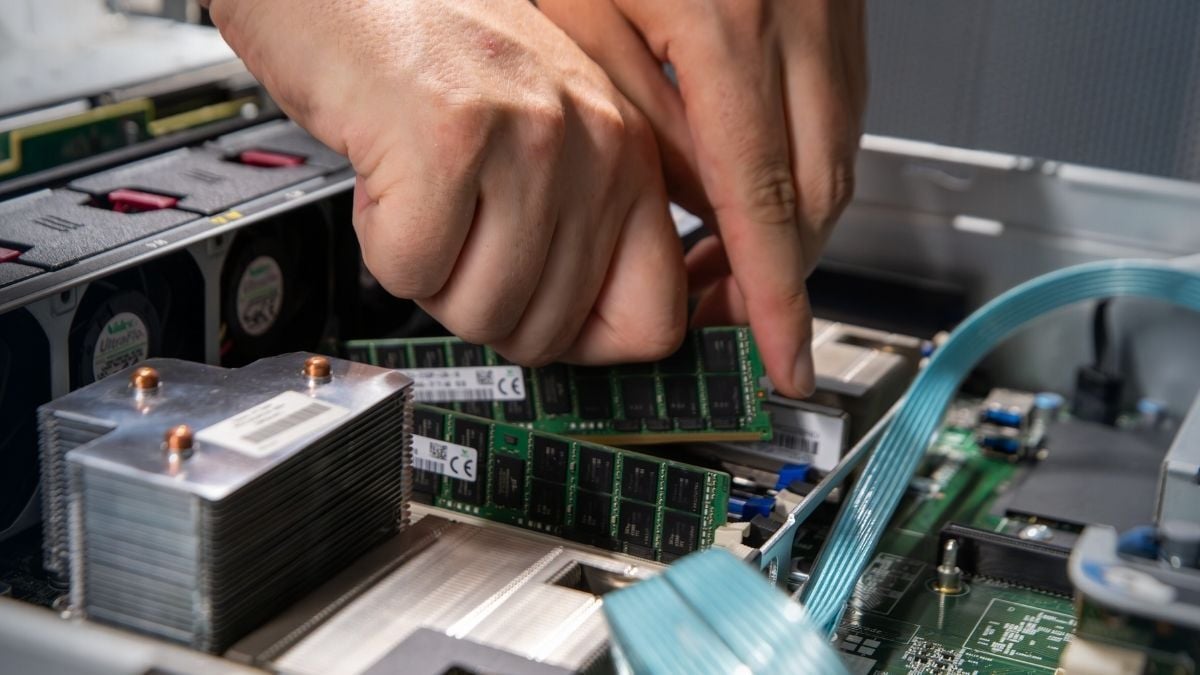
Every infrastructure engineer is currently facing the same budget challenge: hardware costs are climbing. Procuring high-capacity enterprise servers has become a massive capital expenditure (CAPEX) burden. The root cause lies in the intersection of physics and global supply chains. Applications demand massive amounts of memory to function efficiently, while the explosive growth of artificial intelligence is simultaneously choking the global supply of those exact memory components. Understanding this dynamic is essential for keeping your infrastructure costs under control.
The physics of server latency
Data needs to reach the CPU for processing. Latency is the most critical parameter in bare metal environments. Processor clock speeds mean nothing if the CPU is constantly waiting for data to arrive from storage.
The speed difference between RAM memory (10-50 nanoseconds) and modern SSDs (10-100 microseconds) is a factor of 1000. When active data exceeds RAM capacity, the operating system swaps to disk. We spent 160 hours stress-testing NVMe SSD read/write speeds under heavy database loads once RAM caches were exhausted. The raw benchmarks showed query execution times degrading from sub-millisecond to 45+ milliseconds instantly.
When data does not fit into RAM, your whole application stalls. A database must fit entirely in memory. Your virtual servers require dedicated physical memory allocations to function without IOPS bottlenecks. Streaming data buffers must reside in memory to ensure uninterrupted media delivery over high-capacity unmetered network ports.
Why memory and servers are expensive
We are all victims of AI infrastructure demand. Large Language Models (LLMs) and deep learning algorithms work significantly better with more memory. High Bandwidth Memory (HBM) paired with GPUs is currently taking up the majority of global semiconductor production space.
Large technology companies are executing huge CAPEX investments to secure AI capacity. Consequently, standard server RAM is expensive. Major semiconductor foundries have reallocated commodity DRAM production lines to manufacture HBM instead, artificially restricting the supply of standard DDR4 and DDR5 modules.
Furthermore, most enterprise storage is now SSD-based. Solid-state drives utilize the same semiconductor production facilities as memory chips. Because these fabrication plants are booked out for AI hardware, SSDs are also experiencing severe price inflation globally.
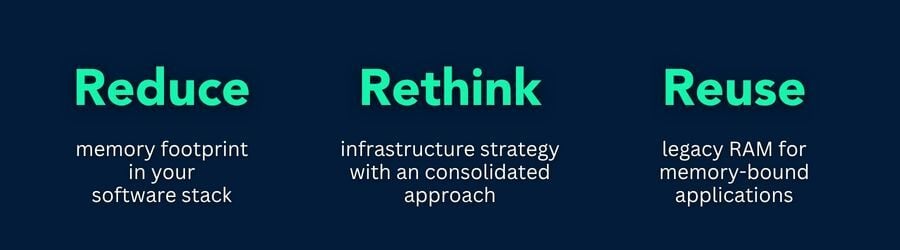
Reduce your memory footprint
A look at the sustainability R's can help generate ideas to lower server costs. The first step is to actively reduce your memory footprint. Research where your software stack can use less memory without sacrificing throughput.
Implement data compression at the application layer to store more data in the same RAM footprint. In virtualization clusters, configure memory ballooning to reclaim unused guest RAM for the hypervisor. Transition away from heavy Virtual Machines (VMs) and use lightweight containers. Containers share the host system's kernel, stripping out the redundant operating system overhead that consumes idle RAM.
Optimize the exact sizing of your virtual machines rather than relying on default over-provisioning. Configure applications to use less filesystem cache where disk I/O allows. For massive datasets, shard your databases. Distribute the load across multiple servers so each specific node only needs to load a strict subset of data into its local memory.
Rethink infrastructure architecture
When absolute peak performance is not required 24/7, rethink your deployment strategy. Consolidation is a powerful tool for cost reduction. One single server equipped with 128GB of RAM can often handle the job of three separate servers with 64GB of RAM each.
Memory and compute resources are dynamically shared between applications. A single, larger server maximizes resource utilization and eliminates the base OS memory tax of running multiple separate host machines. This consolidated approach frequently proves more cost-efficient in terms of hardware leasing, power consumption, and rack space.
Reuse proven hardware generations
On the hardware level, continuing to use older hardware architectures is now a highly logical financial decision. DDR5 memory pricing has exploded, driving up the cost of the latest CPU generations.
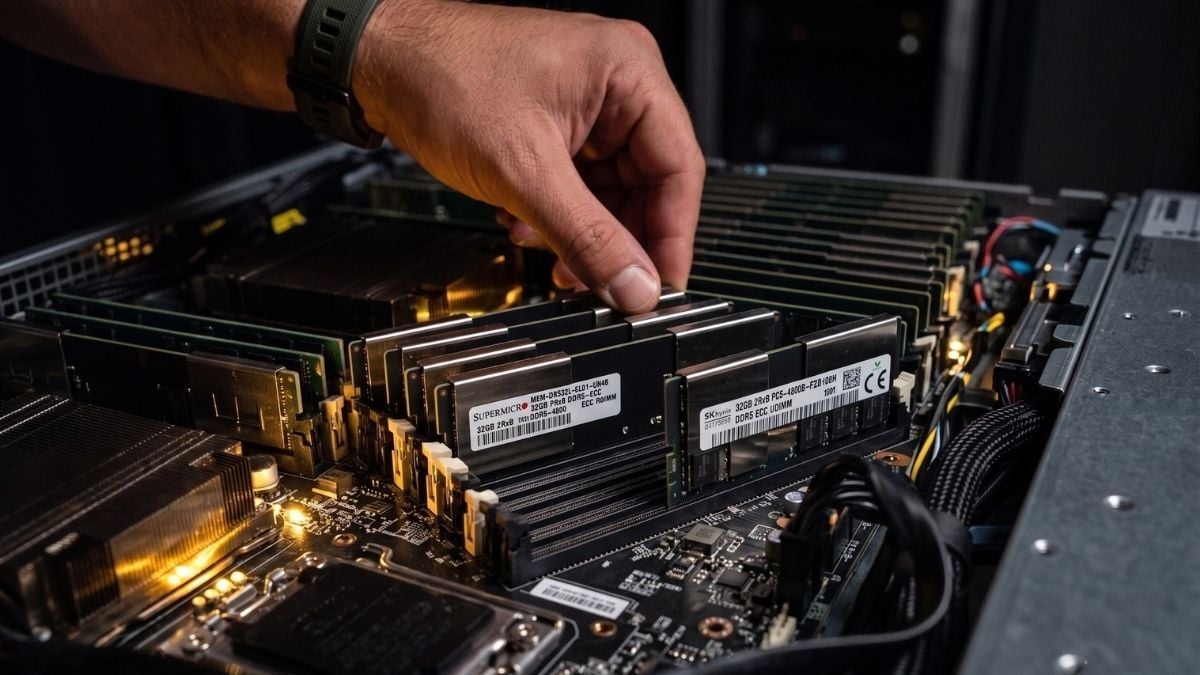
At NovoServe, we maintain a vast inventory of enterprise-grade DDR4 servers. Due to current market dynamics, even DDR3 servers are being kept in production longer. Specifically, legacy servers equipped with massive 512GB DDR3 configurations are incredibly cost-effective. For memory-bound applications where raw capacity matters significantly more than the latest memory bus speeds, these platforms deliver unmatched ROI.