.svg "novoserve-dedicated-server-provider-logo")

Today is the first business day of 2026, and for C-suite leaders, the holiday period has ended with a stark reality check. Veteran analyst Jasper Bakker has just published a scathing review on Tweakers titled De 'soevereine' cloud is vaak een illusie (The 'sovereign' cloud is often an illusion). His analysis is clear: despite a year of marketing fluff about "local regions" and "sovereign zones," the dream of digital independence remains exactly that—an illusion.
The Great Sovereignty Spike
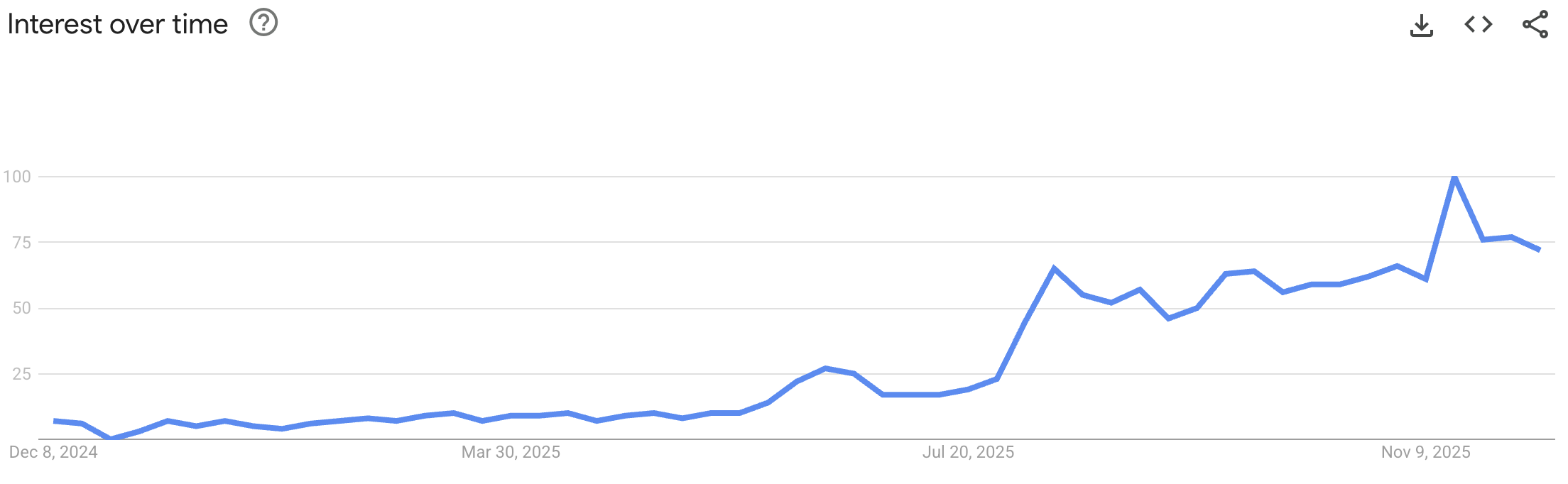
According to recent Google Trends data, search interest in "digital sovereignty" didn't just grow in 2025—it exploded. The interest over time of the “digital sovereignty” term peaked in November 2025 as geopolitical tensions and infrastructure failures reached a breaking point. Organizations are no longer asking if they should be sovereign, but how. The top countries searching this term consist mostly of European countries, Canada, Singapore, Kenya, South Korea and so on.
Jurisdiction Over Residency
The most dangerous misconception in IT today is that 🏠 "data residency" (where data is physically stored) is equivalent to 👑 "data sovereignty" (which laws govern that data).
Many "sovereign" solutions currently on the market—often offered by US-based hyperscalers like AWS, Microsoft, and Google—are not as independent as they seem. Under the US CLOUD Act, any provider headquartered in the United States, or even just owned by a US parent company, is legally compelled to provide access to customer data if requested by US authorities. This applies regardless of whether that data is physically stored in Amsterdam, Frankfurt, or Singapore.
As Bakker points out, even the "European" subsidiaries of these giants remain subject to this extraterritorial reach, creating a "legal limbo" that effectively voids the promise of true sovereignty.
A Global Battlefield: The OVHCloud Case
This is not merely a "US vs. EU" issue; jurisdictional overreach is a global phenomenon. A landmark case from late 2025 involving OVHCloud serves as a chilling example.
The Royal Canadian Mounted Police (RCMP) issued a production order demanding data stored on OVHCloud servers in France, the UK, and Australia. Even though OVH is a French company, a Canadian court ruled that because the company has a "virtual presence" and a subsidiary in Canada, it must hand over European data—ignoring established Mutual Legal Assistance Treaties (MLATs) and potentially forcing the provider to violate French blocking laws.
This "Cloud Thriller" proves that even "sovereign" European providers are vulnerable when they operate global subsidiaries. It highlights a fundamental truth: sovereignty is about legal insulation, not just geography.
The Barriers to Becoming Truly Sovereign
Achieving true sovereignty is difficult because of the deeply entrenched dependencies in our tech stacks:
✅ Hardware Dominance: The production and design of the underlying hardware remain largely in the hands of the US and China, creating a physical dependency that is difficult to circumvent.
✅ The Software Lock-in: While European or open-source alternatives exist, they often face significant compatibility and interoperability challenges. This forces organizations to remain within the Microsoft/Google ecosystems to maintain business continuity.
✅ SaaS Dominance: Because software is increasingly consumed as a service (SaaS), users find themselves entirely dependent on the provider's infrastructure, security protocols, and jurisdictional ties.
Operational Fragility of Public Cloud in 2025
For years, experts like Nienke Bruijn have asked if the public cloud is still safe. In 2025, that question moved from hypothetical debate to operational crisis. The myth of the "indestructible" hyperscale cloud was dismantled by a series of systemic failures:
⚠️ June 12, 2025: A global 3-hour Google Cloud outage hit Spotify, Discord, and Workspace. The cause? A "null pointer" software bug in service control.⚠️ October 20, 2025: A defect in a DynamoDB update triggered a cascading DNS failure in AWS (US-EAST-1). For over 15 hours, global giants and critical banking logistics were paralyzed.
⚠️ October 29, 2025: Only nine days later, an "inadvertent" configuration error in Azure Front Door took down Microsoft 365, Teams, and Outlook globally.
These events proved that a single misconfiguration at a hyperscale provider doesn't just impact one customer—it can effectively silence the digital operations of an entire continent.
Hosting with Real Authority
NovoServe maintains a neutral, architecture-first approach to sovereignty that protects our clients regardless of their location.
How NovoServe guarantees protection for both EU and US clients:
✅ Independent Legal Entities: We operate as two completely independent legal entities in Europe and the US. When you contract with NovoServe B.V. in Europe, your data is governed strictly by EU law and GDPR, legally insulated from the US CLOUD Act. Conversely, when you contract with NovoServe LLC in the US, your data is protected from foreign authorities by the same jurisdictional firewalls.✅ Dedicated Bare Metal Isolation: Hyperscalers rely on a shared "control plane"—a single point of failure. Our Dedicated Bare Metal servers provide your own physical hardware stack, removing the "shared failure" and "noisy neighbor" risks that plagued the public cloud in 2025.
✅ ISO-Certified Governance: NovoServe aligns all security measures with globally recognized standards, including ISO 27001, ensuring a robust and trustworthy environment for all customers.
Is It Time for Your Cloud-Exit?
True sovereignty is not a product—it is a strategy. In 2026, it is no longer enough to rely on a single, foreign-controlled ecosystem. To protect your business, you must balance your risk by diversifying critical workloads into controlled, dedicated infrastructure.
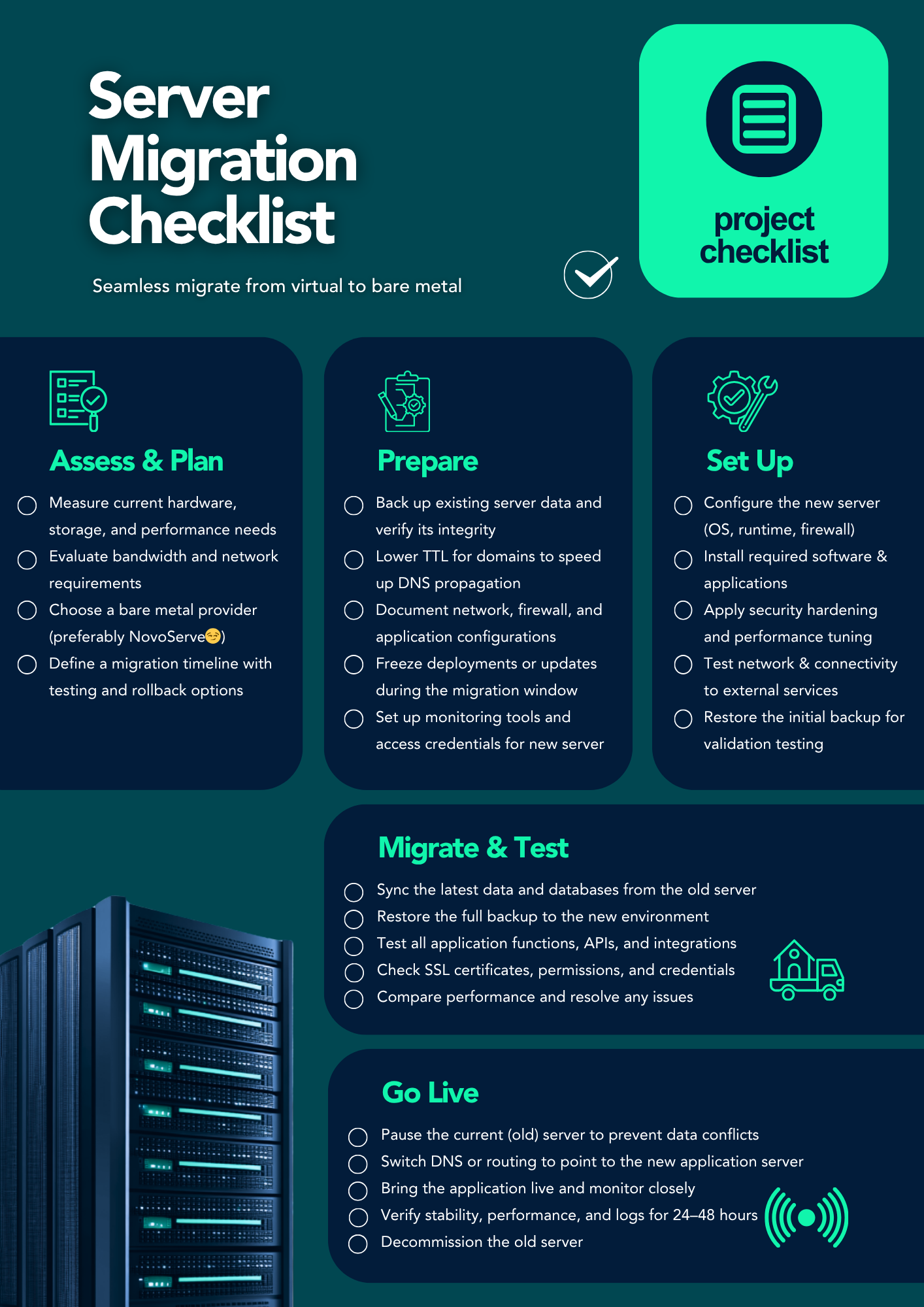
Every successful transition starts with a plan. We invite you to review our 👉 5 Steps to Seamless Dedicated Server Migration: A Practical Checklist