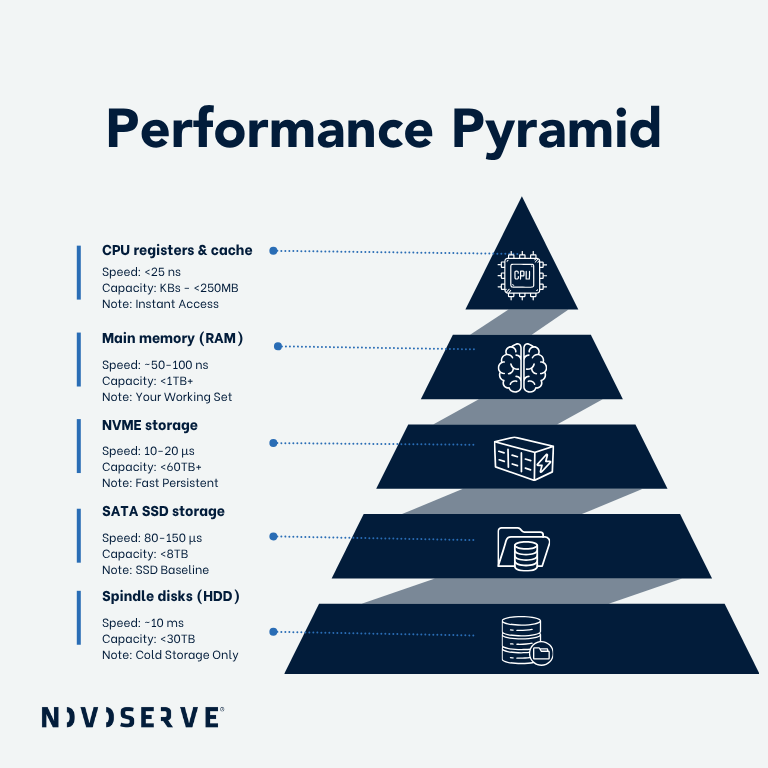
In modern infrastructure, the CPU is rarely the bottleneck. With AMD EPYC processors delivering up to 128 cores per CPU and Intel Xeon Scalable offering massive parallel processing, the constraint has shifted to the I/O subsystem. For workloads like Large Language Model (LLM) training, high-frequency trading (HFT), and real-time big data analytics, the speed at which data travels from persistent storage to system memory is the critical performance metric.
This is where the NVMe dedicated server has become mandatory for intense workloads. We will cover the architectural differences that make NVMe superior to legacy protocols, analyze the bandwidth implications of PCIe Gen4 vs. Gen5, and explain the thermal and mechanical engineering reasons why NovoServe standardizes on U.2 NVMe for enterprise deployments.
The NVMe Protocol Architecture
NVMe (Non-Volatile Memory Express) is not just a faster drive; it is a scalable host controller interface designed from the ground up to exploit the internal parallelism of modern NAND flash arrays.
Legacy protocols like AHCI (Advanced Host Controller Interface)—used for SATA drives—were designed for spinning hard disks with mechanical read/write heads. They introduce significant latency because the CPU must wait for the mechanical nature of the drive.
The Queue Depth Revolution
The most profound architectural difference lies in how commands are queued and executed:
- AHCI (SATA): Operates with a single command queue capable of holding only 32 commands. This creates a massive "traffic jam" for modern multi-core CPUs, forcing them to wait for I/O operations to complete sequentially.
- NVMe Architecture: Supports up to 65,535 (64K) submission and completion queues, with each queue capable of holding 65,536 (64K) commands.
This massive parallelism allows NVMe to map I/O queues directly to CPU cores. A 64-core AMD EPYC processor can have dedicated I/O lanes for every core, ensuring that storage performance scales linearly with compute power. This architecture reduces latency from ~6µs (SATA) to ~2.8µs (NVMe), a critical difference for latency-sensitive applications.

PCIe Gen4 vs. Gen5 Throughput
NVMe drives connect directly to the CPU via the PCIe (Peripheral Component Interconnect Express) bus. The speed of your storage is defined by the generation of this bus and the number of "lanes" (x4) allocated to the drive.
Most modern enterprise servers currently utilize PCIe Gen4, but the industry is rapidly transitioning to PCIe Gen5 to support AI workloads.
- PCIe Gen4: Delivers 16 GT/s (Giga-transfers per second). A standard x4 NVMe drive on Gen4 can reach theoretical throughputs of ~8 GB/s. This is the current standard for high-performance databases.
- PCIe Gen5: Doubles the throughput to 32 GT/s. A Gen5 x4 NVMe drive can push ~16 GB/s.
Why this matters for 2026: For AI/GPU servers, data must be fed into the GPU memory (HBM3) as fast as possible to prevent the GPU from idling. PCIe Gen5 NVMe storage is essential to saturate the bandwidth of NVIDIA H100 systems, ensuring your expensive GPUs are never waiting on data.
M.2 vs. U.2 in the Data Center
When configuring a server, you often see two physical standards for NVMe: M.2 and U.2. While they may use the same underlying silicon and protocol, their mechanical and thermal characteristics make them suited for very different environments.
M.2: The Consumer "Gum Stick"
The M.2 form factor (2280) was designed for laptops and consumer desktops where space is at a premium.
- Thermal Challenges: M.2 drives have very limited surface area for heat dissipation. Under sustained enterprise write loads, M.2 drives often hit their thermal junction limits and throttle (slow down) to prevent damage.
- Serviceability: M.2 drives are screwed directly onto the motherboard or internal riser cards. Replacing a failed drive requires downtime: the server must be powered off, un-racked, and opened. This is unacceptable for high-availability SLAs.
U.2: The Enterprise Standard
The U.2 form factor uses a 2.5-inch drive housing, similar to a traditional SSD, but connects via a high-density SFF-8639 connector that carries 4 lanes of PCIe signals.
- Thermal Management: The 2.5-inch aluminum case acts as a large heatsink. In a server chassis, U.2 drives are positioned at the front, directly in the path of high-velocity airflow from the cooling fans. This allows them to run at peak performance 24/7 without thermal throttling.
- Signal Integrity: The U.2 connector is designed for strict impedance matching and signal integrity, reducing data transmission errors at Gen4 and Gen5 speeds.
- Hot-Swappability: The defining feature for data centers. U.2 drives can be removed and replaced while the server is running. This allows for zero-downtime maintenance and effortless RAID rebuilds.
NovoServe U2 NMVe Storage Solution
At NovoServe, we prioritize stability and uptime above all else. For this reason, our high-performance dedicated storage server fleet is architected around U.2 NVMe technology.
Maximum Density & Serviceability Our flagship chassis—including the HPE ProLiant DL360, DL380, DL325 and DL385 —are configured with specific backplanes to support 8x U.2 NVMe slots upfront. This allows you to build massive, high-speed storage arrays (RAID 10 or ZFS pools) that are easy to manage and upgrade.
Cost-Effective Performance We leverage our supply chain to make enterprise-grade U.2 storage accessible. You can deploy high-endurance drives ranging from 1.92TB up to massive 15.36TB capacities and more. Contrary to the belief that enterprise tech is unaffordable, our NVMe upgrades start from just €35 per drive, democratizing access to million-IOPS performance.
Upgrade to an NVMe Storage
Don't let your storage be the bottleneck that throttles your application. Whether you are building a distributed database, a high-frequency trading node, or an AI inference engine, U.2 NVMe provides the thermal stability and raw throughput required for 2026 workloads. Speak to us and let's upgrade your infrastructure to NVMe storage right away.